Duration
5 Years (10 semesters)
Max Completion
7 Years from Admission
ADMISSIONS OPEN
2026-27
10
Semesters
7yrs
Max Period
BCI
Approved
2026–27
ADMISSIONS OPEN 2026-27
The B.A. LL.B (5-year Integrated Degree) Programme combines legal education with humanities and social sciences, offering a structured pathway for students seeking to pursue careers in litigation, judiciary, civil services and public law.
The integrated curriculum provides grounding in constitutional and criminal law while fostering critical engagement with questions of governance, rights and social justice. This academic learning is supported by moot courts, internships and legal aid activities, ensuring practical exposure alongside doctrinal study.
Graduates of the programme are prepared for professional practice, judicial services examinations, civil services, academia and related roles within the legal profession.
Programme Details
Degree
B.A LL.B.
Type
Undergraduate
Duration
5 Years (10 semesters)
Max Period
7 Years from Admission
Affiliation
KSLU, Hubballi
Approved By
Bar Council of India
Programme Outcome

01
To allow students to explore a wide range of disciplines to develop a comprehensive understanding of society, politics, and culture, in addition to the law.

01
To provide students with an in-depth and comprehensive legal education that covers various aspects of law, including both general and specialised areas.

01
To foster a culture of legal research, scholarly writing and critical analysis, encouraging students to contribute to legal academia.

01
To equip students with the necessary skills and knowledge to excel in the legal profession, including legal practice, advocacy, and ethical conduct.

01
To expose students to International and Comparative Law, promoting a global perspective and understanding to legal systems beyond their jurisdiction.

01
To offer opportunities for students to specialise in specific areas of law, enabling them to develop expertise in fields such as Environmental Law, Intellectual Property, Human Rights or Corporate Law.
Programme Objectives
Eligibility Criteria
Academic Qualification
Candidates seeking admission to the 5-year B.A. LL.B. Integrated Degree Programme must have completed a Pre-University Course or Senior Secondary School Examination (10+2 pattern) from an institution recognised by the Central or State Government in India.
Applicants who have completed an equivalent qualification from a foreign institution recognised by the government of that country and recognised in India are also eligible to apply.
Admission shall be granted in accordance with the regulations of Karnataka State Law University, Hubballi.
Foreign Nationals
Foreign Nationals seeking admission are eligible, subject to the fulfilment of the prescribed eligibility conditions. The Admission Committee shall determine the equivalence of the qualifying examination for admission.
Percentage of Marks
Category
Min. Marks
General Merit
45%
OBC Category
42%
SC / ST / Cat-I
40%
Age Requirement
The age of the candidate at the time of admission shall be in accordance with the norms prescribed by BCI.
Curriculum Highlights
For a detailed semester-wise breakdown of subjects and credits, refer to the full syllabus.
Diverse Career Paths
Teaching Methodology
The teaching methodology at RVILS combines rigorous doctrinal study with structured practical exposure, preparing students to apply legal principles in real-world situations with clarity and confidence.
Classroom learning is rigorous and participative. Faculty members use case-law analysis, statutory interpretation, structured discussions, debates, problem-based learning and moot simulations to build critical reasoning and advocacy skills. Emphasis is placed on constitutional values and the application of law to contemporary issues.
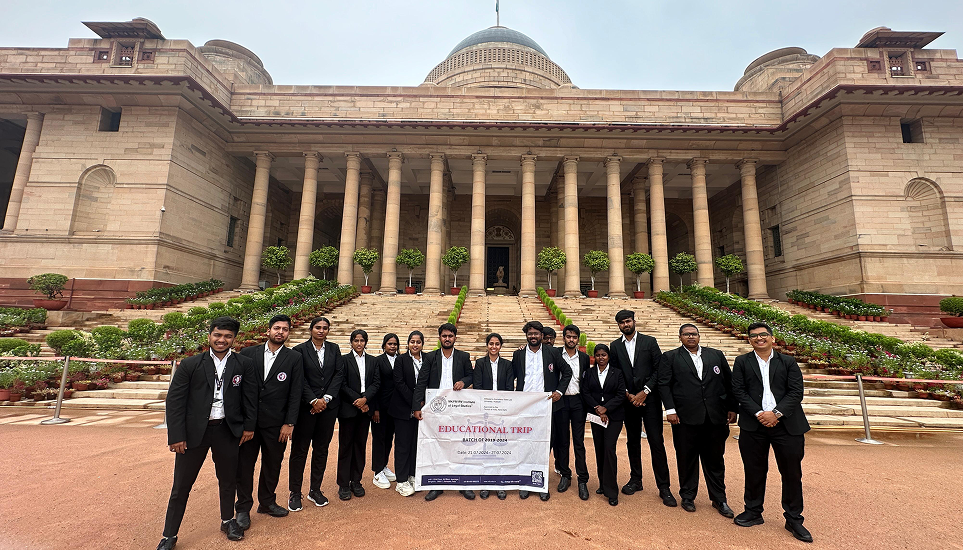
To bridge theory and practical knowledge, organised visits are conducted to courts, tribunals, prisons, police stations, forensic laboratories, legislative bodies and legal aid centres. These engagements provide first-hand insight into the functioning of the justice delivery system and deepen understanding of procedural and institutional processes.